13
d'Abril
de
2016 - 09:59
Long gone are those days when Miami was merely known as the home of Julio Iglesias. Conxita Muñoz, director of the Acció office in what some call the "capital of Latin America", confirms this after spending 35 years living in the city. In fact, she opened the office in 1996, making this year the 20th anniversary of a project that helps Catalan companies to become established in the United States and Central America from the state of Florida.
In fact, more than 50% of the Catalan companies that come to the United States do so through Miami. It is a city, as Muñoz describes it, that is especially interested in attracting businesses from different sectors, such as technology start-ups, those in tourism and cruises, biomedicine, import/export between North and South America, and international banking.
"Florida is strategically located between the United States and Latin America, it has become a centre for the redistribution of services and products between the two continents," she tells VIA Empresa. This fact, she says, makes it "a very good gateway for European companies." The US market "has a lot of restrictions and regulations, and it needs hard work to become a success," she warns. However, at the same time, choosing Miami helps "to start doing business with Central America, the Caribbean or Latin America, while carrying out the whole process of homologation in the United States."
A city with an open mind
For the past five years, Miami has also been the home of Alexis Cogul, a Catalan architect who founded DOO Architecture there, while maintaining his links with Barcelona through the Danda company. What he highlights about the city is its "open mentality due to the very strong Latin influence." Cogul recalls an ironic phrase that is often heard: "the only bad thing about Miami is that it is close to the United States."
A joke it may be, but it is based on a North American ecosystem infused with a Latin or European spirit. "The people in the most powerful political or business positions are Latins. The America in Miami has to be very open, and provides a contrast to the typical, more closed and class-based American city," he says.
Conxita Muñoz concurs, adding that "doing business in Miami or in Florida is to do it in the United States, with the logic, protection and guarantees that the country offers." However, this is also done with "a more open and receptive mentality to international products than you find in Atlanta or Houston. They are very powerful cities, but very deep America, without the international character you find in New York, Miami or Los Angeles," she says.
Muñoz insists that the United States is "a very large country but one quite wrapped up in itself, except in the more international areas. There are a lot of more closed places, and this is how they differ from Miami".
Fun in Spanish, business in English
"I have come across some businesses that want to begin with Miami because their catalogues are in Spanish and they do not even have a website in English," laments Conxita Muñoz. It is a decision that is a complete misstep. "In Miami you can have fun and go out in Spanish, but if you want to do business it has to be in English," she says firmly. Nevertheless, the director of the Acció office in Miami admits that "speaking Spanish opens a lot of doors. There are a lot of job offers that require bilingual people."
Whatever the case, she insists that "business dealings are very American. It has to be in English to understand the American mentality." For all that you can order in Spanish in a restaurant, you have to be able to conduct business in English.
Alexis Cogul confirms this vision, and states that "the professional world is 100% in English. Everyone speaks Spanish, but the work is in English." In fact, he highlights as common "speaking in English with someone even though you know well that they speak perfect Spanish." The role of the Hispanic language is for such things as "breaking the ice, as English is a lot more formal."
Everyone talks to everyone
Human relationships are one thing that Alexis Cogul highlights as a positive factor in Miami. Even though hierarchies are maintained in companies, he insists that in social situations it much easier to approach anyone. "You relate much more easily on different levels. To reach relate to people at certain levels in Barcelona you have to go to different places. Here everyone goes to the same places and you can find anyone at social events," says Cogul.
This provides the chance to talk to anyone. "When people go out they are very open to talking to anyone, new talent and young people. They do not classify you according to where you come from or who you are, but rather by what you know," he explains.
Dinner early, although not too early
As for working timetables, both Conxita Muñoz and Alexis Cogul do not see many significant differences with Catalonia. "Between 8 and 9am everyone begins work. Lunch is not such a big thing and usually happens in 30 or 45 minutes at the office or nearby," says Muñoz.
In the evening, the day usually ends between 5 and 6pm. The main difference is dinner time, as Americans normally eat around 7pm. "10 o'clock at night is already late. When I went to Barcelona the days seemed very long," Conxita Muñoz jokes.
Nevertheless, the Latins tend to make the day last a little longer. "They have dinner between 8 or 9pm," says Cogul, who warns that "most restaurants close their kitchens at 10pm, except in the more touristy area of Miami Beach."
Yet, if there is one thing that everyone shares in Miami it is the warm climate, which is almost tropical. "We get a wet season when it rains every day and you have to adapt," says Muñoz. However, more than rain, what she most laments is that "the air conditioning is on full blast everywhere you go. You have to take a sweater to work because the buildings are very cold." In fact, she concludes with a little secret: "all of the girls in the office have a heater next to them to compensate for the air conditioning. It is madness!"
In fact, more than 50% of the Catalan companies that come to the United States do so through Miami. It is a city, as Muñoz describes it, that is especially interested in attracting businesses from different sectors, such as technology start-ups, those in tourism and cruises, biomedicine, import/export between North and South America, and international banking.
"Florida is strategically located between the United States and Latin America, it has become a centre for the redistribution of services and products between the two continents," she tells VIA Empresa. This fact, she says, makes it "a very good gateway for European companies." The US market "has a lot of restrictions and regulations, and it needs hard work to become a success," she warns. However, at the same time, choosing Miami helps "to start doing business with Central America, the Caribbean or Latin America, while carrying out the whole process of homologation in the United States."
A city with an open mind
For the past five years, Miami has also been the home of Alexis Cogul, a Catalan architect who founded DOO Architecture there, while maintaining his links with Barcelona through the Danda company. What he highlights about the city is its "open mentality due to the very strong Latin influence." Cogul recalls an ironic phrase that is often heard: "the only bad thing about Miami is that it is close to the United States."
A joke it may be, but it is based on a North American ecosystem infused with a Latin or European spirit. "The people in the most powerful political or business positions are Latins. The America in Miami has to be very open, and provides a contrast to the typical, more closed and class-based American city," he says.
Conxita Muñoz concurs, adding that "doing business in Miami or in Florida is to do it in the United States, with the logic, protection and guarantees that the country offers." However, this is also done with "a more open and receptive mentality to international products than you find in Atlanta or Houston. They are very powerful cities, but very deep America, without the international character you find in New York, Miami or Los Angeles," she says.
Muñoz insists that the United States is "a very large country but one quite wrapped up in itself, except in the more international areas. There are a lot of more closed places, and this is how they differ from Miami".
 |
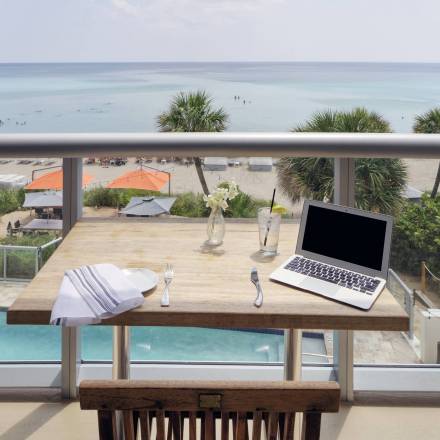
| Miami is the gateway to the United States for many European businesses. L.Corbella |
Fun in Spanish, business in English
"I have come across some businesses that want to begin with Miami because their catalogues are in Spanish and they do not even have a website in English," laments Conxita Muñoz. It is a decision that is a complete misstep. "In Miami you can have fun and go out in Spanish, but if you want to do business it has to be in English," she says firmly. Nevertheless, the director of the Acció office in Miami admits that "speaking Spanish opens a lot of doors. There are a lot of job offers that require bilingual people."
Whatever the case, she insists that "business dealings are very American. It has to be in English to understand the American mentality." For all that you can order in Spanish in a restaurant, you have to be able to conduct business in English.
Alexis Cogul confirms this vision, and states that "the professional world is 100% in English. Everyone speaks Spanish, but the work is in English." In fact, he highlights as common "speaking in English with someone even though you know well that they speak perfect Spanish." The role of the Hispanic language is for such things as "breaking the ice, as English is a lot more formal."
Everyone talks to everyone
Human relationships are one thing that Alexis Cogul highlights as a positive factor in Miami. Even though hierarchies are maintained in companies, he insists that in social situations it much easier to approach anyone. "You relate much more easily on different levels. To reach relate to people at certain levels in Barcelona you have to go to different places. Here everyone goes to the same places and you can find anyone at social events," says Cogul.
This provides the chance to talk to anyone. "When people go out they are very open to talking to anyone, new talent and young people. They do not classify you according to where you come from or who you are, but rather by what you know," he explains.
Dinner early, although not too early
As for working timetables, both Conxita Muñoz and Alexis Cogul do not see many significant differences with Catalonia. "Between 8 and 9am everyone begins work. Lunch is not such a big thing and usually happens in 30 or 45 minutes at the office or nearby," says Muñoz.
In the evening, the day usually ends between 5 and 6pm. The main difference is dinner time, as Americans normally eat around 7pm. "10 o'clock at night is already late. When I went to Barcelona the days seemed very long," Conxita Muñoz jokes.
Nevertheless, the Latins tend to make the day last a little longer. "They have dinner between 8 or 9pm," says Cogul, who warns that "most restaurants close their kitchens at 10pm, except in the more touristy area of Miami Beach."
Yet, if there is one thing that everyone shares in Miami it is the warm climate, which is almost tropical. "We get a wet season when it rains every day and you have to adapt," says Muñoz. However, more than rain, what she most laments is that "the air conditioning is on full blast everywhere you go. You have to take a sweater to work because the buildings are very cold." In fact, she concludes with a little secret: "all of the girls in the office have a heater next to them to compensate for the air conditioning. It is madness!"