20
de Gener
de
2016 - 09:40
Act.
20
de Gener
de
2016 - 9:40
Life sciences want a place in the shop window of good ideas and to attract investors. Two examples of this are Minoryx Therapeutics and Oryzon, two cases that have begun to make progress, with the Barcelona start-up Mind the Byte close behind.
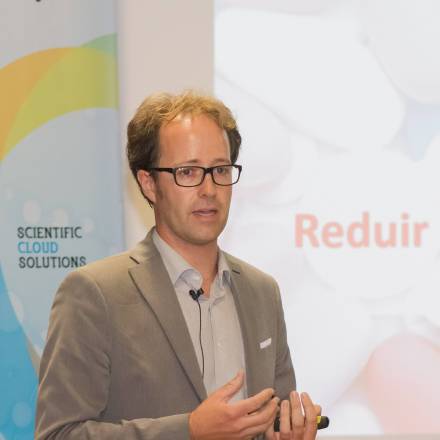
Set up in 2011 by Alfons Nonell-Canals, the company has developed a programme capable of reducing the time it takes to develop and launch drugs on the market. Its name is iMols and it is based on the SaaS (Software as a Service) approach.
A "very tough" start
Nonell-Canals is a graduate in Chemistry from the Universitat de Barcelona, with a doctorate in Theoretical and Computational Chemistry from the URV and, as he explained to VIA Empresa, it was in the last stage of his post-doctorate at the Universitat Pompeu Fabra that he decided to combine research with becoming an entrepreneur. "I began in 2008, the crisis had started and was being felt in research, every day I had to negotiate with my boss; and so I decided to jump in the deep end, leave the university and set up my own company," he recalls.
It is no surprise, then, that the story of the start-up's beginnings followed the same old pattern: a single person, the company HQ in the founder's house and minimum resources. "It was very tough," the CEO admits with a faint smile. A little while afterwards his salvation arrived: "Two friends joined as partners. One of them is a former colleague from my thesis days who had done an MBA and who took charge of the financial issues; the other was a friend who focused more on research."
As for funding, Nonell-Canals states that companies that "only sell knowledge, like Mind the Byte, there is no need for large investment" and he puts the figure at around 20,000 euros, all coming from FFF, unemployment benefit and a bank loan.
Science and business, a difficult pairing
The CEO summarises the two sources of income: "On the one hand, clients; on the other, public sources, which are good for innovation and research."
Among the offer of public funds, the founder highlights the Horizon 2020 programme, which includes the Datanimbus project thanks to the support received from Acció. In July 2015, it received 50,000 euros from the European Commission for this programme that applies Big Data in medicine to improve and personalise the attention to patients.
The start-up ended 2014 with a turnover of 42,000 euros, "very little" says Nonell-Canals, who makes it clear that they still do not have enough clients to survive from their own income. "It is hard to get into the academic world if you want to sell, because the software costs 50 euros per use, and academia sometimes bargains over this price even with a critical mass that in theory makes it easier to get into," he says about the difficulties of doing business. And even though it might seem that the business environment is easier to get into, the CEO says that is not the case: "They do dynamic research and take on much more of the costs, but they ask for guarantees and proof, they want a good product and that is why some clients evaluate our software before purchasing it. Selling is hard, but little by little we are chipping away and creating trust."
To the 42,000 euros in revenue has to be added resources coming from grants, making total revenue of 300,000 euros to develop all the commercial and research activity in 2014.
To Denmark with a large round of investment
Without realising it, Mind the Byte ended 2015 with a record: the largest round of crowdfunded investment in Spain at 235,490 euros, double the objective set and through the Crowdcube platform. And what makes the achievement more notable is that it is the second increase in capital in less than a year, the first was 200,000 euros and was led by Inkemia, a holding company for biotechnology SMEs on the MAB alternative stock market.
With this injection of capital and the arrival of 115 new partners, the start-up will this year focus on international expansion. In fact, the main aim is to consolidate the expansion it already began at the end of 2014 in Denmark with the opening of the subsidiary Mind the Byte ApS in the Copenhagen Bio Science Park. This also allows them to be within the Medicon Valley Region, the biotech cluster made up of 12 universities, 32 hospitals, seven science and technology parks and 650 companies in the sector.
The move into Copenhagen means, according to Nonell-Canals, entering a market made for "small and large pharmaceutical and biotech companies as if in Catalonia," but with the difference that it is a "huge" ecosystem. "There are many more companies there, it is a very large and powerful cluster, and the large companies are more accessible," adds the CEO, who insists that the academic world has the habit of working with new projects that appear and that can help boost Mind the Byte.
Opting for a subsidiary in its international strategy is also down to the greater ease that comes from presenting oneself as a Danish company. "It gives you a brand when you go abroad to sell, they appreciate that you come from Copenhagen," he points out.
Working with Amazon
Joining Medicon Valley and the Horitzó 2020 programme are not the only signs of quality for the start-up, another is being a technology partner of Amazon Web Services.
Mind the Byte pays money every year to Amazon to use its cloud computing service, the multinational evaluates the work they do and offers the support of its engineers whenever they need it. To understand it quickly, Nonell-Canals explains that it is like a "label of trust and certifies the security of the infrastructure."
Mind the Byte is the only AWS partner in Spain and, according to the CEO, "one of the five or six it has in the whole world.
Set up in 2011 by Alfons Nonell-Canals, the company has developed a programme capable of reducing the time it takes to develop and launch drugs on the market. Its name is iMols and it is based on the SaaS (Software as a Service) approach.
A "very tough" start
Nonell-Canals is a graduate in Chemistry from the Universitat de Barcelona, with a doctorate in Theoretical and Computational Chemistry from the URV and, as he explained to VIA Empresa, it was in the last stage of his post-doctorate at the Universitat Pompeu Fabra that he decided to combine research with becoming an entrepreneur. "I began in 2008, the crisis had started and was being felt in research, every day I had to negotiate with my boss; and so I decided to jump in the deep end, leave the university and set up my own company," he recalls.
It is no surprise, then, that the story of the start-up's beginnings followed the same old pattern: a single person, the company HQ in the founder's house and minimum resources. "It was very tough," the CEO admits with a faint smile. A little while afterwards his salvation arrived: "Two friends joined as partners. One of them is a former colleague from my thesis days who had done an MBA and who took charge of the financial issues; the other was a friend who focused more on research."
As for funding, Nonell-Canals states that companies that "only sell knowledge, like Mind the Byte, there is no need for large investment" and he puts the figure at around 20,000 euros, all coming from FFF, unemployment benefit and a bank loan.
Science and business, a difficult pairing
The CEO summarises the two sources of income: "On the one hand, clients; on the other, public sources, which are good for innovation and research."
Among the offer of public funds, the founder highlights the Horizon 2020 programme, which includes the Datanimbus project thanks to the support received from Acció. In July 2015, it received 50,000 euros from the European Commission for this programme that applies Big Data in medicine to improve and personalise the attention to patients.
The start-up ended 2014 with a turnover of 42,000 euros, "very little" says Nonell-Canals, who makes it clear that they still do not have enough clients to survive from their own income. "It is hard to get into the academic world if you want to sell, because the software costs 50 euros per use, and academia sometimes bargains over this price even with a critical mass that in theory makes it easier to get into," he says about the difficulties of doing business. And even though it might seem that the business environment is easier to get into, the CEO says that is not the case: "They do dynamic research and take on much more of the costs, but they ask for guarantees and proof, they want a good product and that is why some clients evaluate our software before purchasing it. Selling is hard, but little by little we are chipping away and creating trust."
To the 42,000 euros in revenue has to be added resources coming from grants, making total revenue of 300,000 euros to develop all the commercial and research activity in 2014.
To Denmark with a large round of investment
Without realising it, Mind the Byte ended 2015 with a record: the largest round of crowdfunded investment in Spain at 235,490 euros, double the objective set and through the Crowdcube platform. And what makes the achievement more notable is that it is the second increase in capital in less than a year, the first was 200,000 euros and was led by Inkemia, a holding company for biotechnology SMEs on the MAB alternative stock market.
With this injection of capital and the arrival of 115 new partners, the start-up will this year focus on international expansion. In fact, the main aim is to consolidate the expansion it already began at the end of 2014 in Denmark with the opening of the subsidiary Mind the Byte ApS in the Copenhagen Bio Science Park. This also allows them to be within the Medicon Valley Region, the biotech cluster made up of 12 universities, 32 hospitals, seven science and technology parks and 650 companies in the sector.
The move into Copenhagen means, according to Nonell-Canals, entering a market made for "small and large pharmaceutical and biotech companies as if in Catalonia," but with the difference that it is a "huge" ecosystem. "There are many more companies there, it is a very large and powerful cluster, and the large companies are more accessible," adds the CEO, who insists that the academic world has the habit of working with new projects that appear and that can help boost Mind the Byte.
Opting for a subsidiary in its international strategy is also down to the greater ease that comes from presenting oneself as a Danish company. "It gives you a brand when you go abroad to sell, they appreciate that you come from Copenhagen," he points out.
Working with Amazon
Joining Medicon Valley and the Horitzó 2020 programme are not the only signs of quality for the start-up, another is being a technology partner of Amazon Web Services.
Mind the Byte pays money every year to Amazon to use its cloud computing service, the multinational evaluates the work they do and offers the support of its engineers whenever they need it. To understand it quickly, Nonell-Canals explains that it is like a "label of trust and certifies the security of the infrastructure."
Mind the Byte is the only AWS partner in Spain and, according to the CEO, "one of the five or six it has in the whole world.