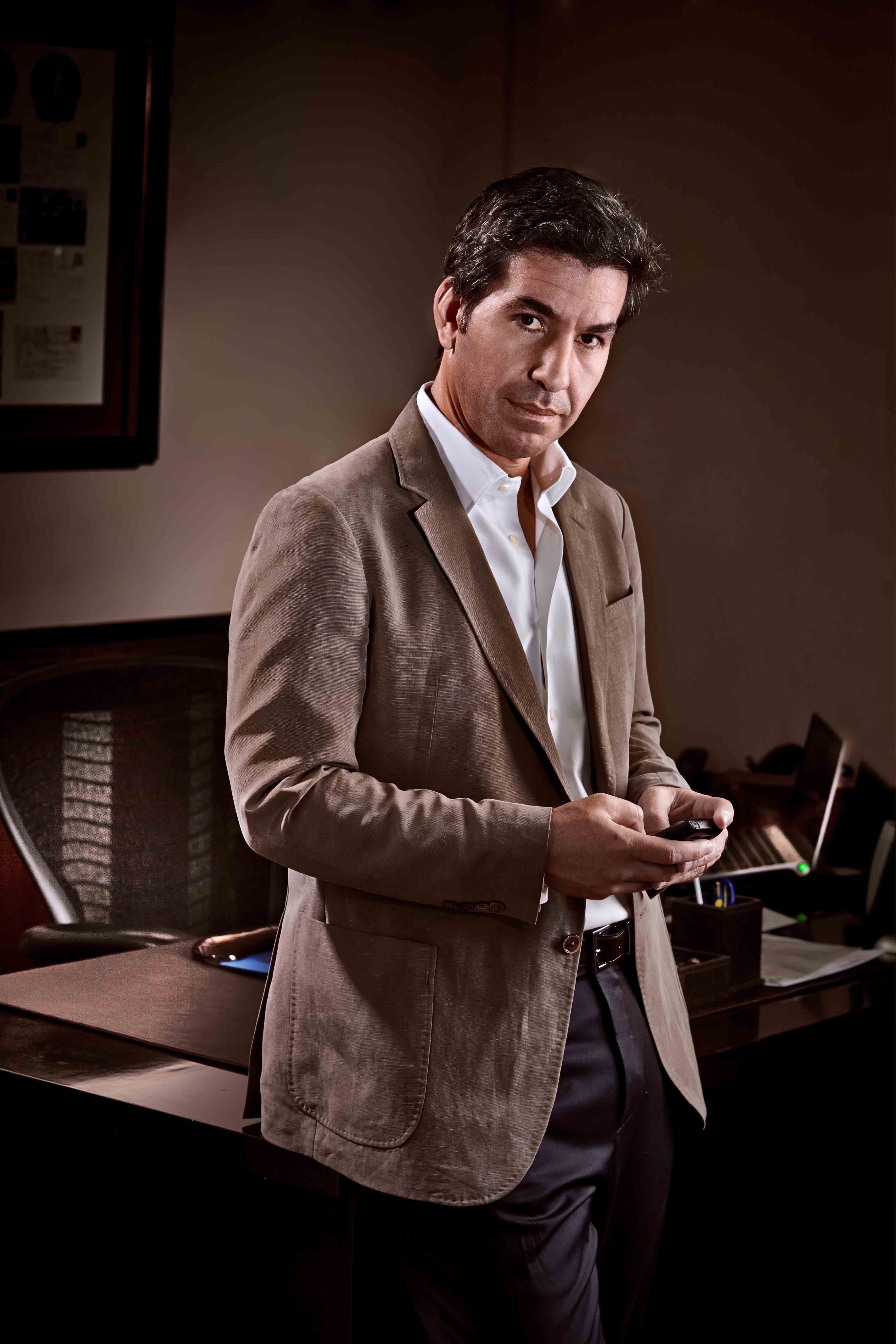
He is no Daniel Scioli or Mauricio Macri, the two candidates for president in Argentina, but Andy Freire (@andyfreire, Buenos Aires, 1972) is a leading public figure in the South American country. In his case, he is one of the leading lights of the entrepreneurial ecosystem in Argentina and the whole of Latin America. With a degree in Economy from the University of St Andrews and an OPM from Harvard Business School, he is an entrepreneur in the business and social spheres. He co-founded and heads Officenet, a company that revolutionised the industry of office material distribution in Latin America. Later on, he co-founded Axialent, a consultancy that helps the largest companies in the world to improve their organisational culture. The same thing he did later with Restorando and Quasar Ventures.
Recognised as a Global Leader for Tomorrow in 2000 by the World Economic Forum, Latin American Entrepreneur of the Year in 2001 by the Endeavor Foundation, and World Young Business Achiever in 2002; in 2008 the World Economic Forum in Davos (Switzerland) awarded him the distinction of being among the 100 Young Global Leaders of the World.
Freire is member of the Global Advisory Council of Harvard Business School and one of four global judges for the Dell Business Excellence Award. He was president of the Endeavor Foundation in Argentina and today presides over the Fundación Argentina Emprendedora. In this interview with VIA Empresa he reviews the keys of entrepreneurship in the modern world, the situation in Argentina, which is currently holding presidential elections, as well as the whole of South America.
Are entrepreneurs born or made? Which is your case?
This issue is a never-ending debate in the business world. There are those who think it is impossible to alter innate characteristics, and who state that this is decisive when starting a business. However, others insist that "everything is made, nothing is innate, everything can be developed." I am somewhere in the middle. I think there is a layer of technical habits that are easy to acquire and modify.
What are they?
They are about training and educational learning. How to obtain starting capital, how to develop a commercial and financial strategy, how to create a business plan, among many other questions, are knowledge and abilities that are acquired with academic and technical learning. At the other extreme, in the deepest part of the entrepreneur, there is a neuronal layer of unmodifiable talents, which you either have or you don't. These are the abilities that, as they say, "are in the blood" and that cannot be acquired through willpower, no matter how obstinate you are. The work of Martin Seligman is very useful on this issue: What you can Change… and what you can't shows that there are recurrent patterns of thinking and behaviour that belong to the physiology of each person, as a product of genetics and pre-pubescent influences that determine the neurological system. Given this, it is very probable that, for example, I will never be able to develop the charisma of Bill Clinton or the vision of Bill Gates; but the question to ask is whether that is the only thing that matters or if the relevant thing is to do better within my possibilities. I incline towards the latter.
You dedicate a good part of your time to promoting leadership and entrepreneurship. Why are they so important?
The world has a structural problem: the scarce capacity to create jobs. In this context, entrepreneurs have a radical importance. To get an idea of the extent of this role, you need only look at the figures: some 90% of new jobs in the United States are created by the work of entrepreneurs. In Europe, this figure -in the post-crisis years- was 80%. Entrepreneurs, apart from creating jobs, are a fundamental source of innovation. Different research shows a direct relationship between the volume of entrepreneurial activity and the capacity of a country to introduce substantial and positive changes. For example, some 95% of radical innovation in the United States since the Second World War has come from small start-ups.
The world is also changing...
In the past 30 years, the world has undergone dizzying transformation, unlike any other period in history. These changes, based on technology, have allowed for the creation of networks of commercial relations that were unimaginable a few decades ago. Globalisation of associations did away with conventional physical limits. Now we not only talk of a globalisation and fragmentation of productive chains, but also that of services. The spatial dimension has been revitalised. Nothing with a minimum degree of innovation is now made wholly in one single country. The "made in" phrase is dead, as chains of production have fragmented across national borders. All anyone with an iPhone has to do is look at the back to see: "Designed by Apple in California. Assembled in China". However, while this phrase is illustrative, it is still not the whole picture as it only includes the countries at either end of the chain of production of the most famous phone in the world. To be fair, we would have to add that there are companies involved in its manufacture from at least seven different countries: United States, the UK, Germany, South Korea, Japan, Taiwan and China.
Has this caused a change in the world economic order?
Without a doubt, the economic and geopolitical map has shifted its axis. In 2012, according to data from the World Investment Report 2013, the so-called emerging countries surpassed -for the first time- developed countries as the main destination of Foreign Direct Investment (FDI). You need only look at the demographic phenomenon to see the true dimension of this reality: in China alone, 20 million people move from the countryside to the city every year. That is the equivalent of the whole of Argentina every two years beginning to consume higher value products, which raises the volume of world demand. Thank to this phenomenon –which on the other hand presents an opportunity for a food producer like Argentina- the Organisation for Economic Co-operation and Development (OECD) estimates that the global middle class will go from 2 billion people today to 5 billion people in 2030. Then, China will be the world's main economic power; India, will be the third, with Brazil and Russia fighting it out for fourth and fifth place. In that context, the speed of change, the disappearance of traditional physical barriers, the new economic powers and the middle classes in expansion are leading factors that will generate great opportunity for many countries, especially those that can develop innovative entrepreneurial ecosystems.
With what consequences?
This is not abstract nor a utopian dream. It is a reality that many are already exploiting: How did Israel transform itself in less than 30 years into the third most important country in terms of the number of its companies listed on the Nasdaq?; How did Estonia -after the fall of the Soviet Union- develop an ecosystem of technology companies of which Skype is the best-known?; How did Rwanda get back on its feet -at least from the point of view of some economic indicators- after the massacres of 1994 in which more than a million of its inhabitants were killed? The answer in all these cases –and in many others, too- is the same: they understood the world's new dynamic and undertook sustainable processes to integrate into it and formed entrepreneurial ecosystems. 
Which values are basic for starting businesses?
I believe that the key to success for any entrepreneur comes from being able to positively respond to the following questions:
1- Am I a committed entrepreneur? In this case, a curious phenomenon happens that is seen quite a lot all over the world: Argentina is among the foremost countries with a high rate of generating new entrepreneurs. Nevertheless, in terms of the percentage of projects that fail, Argentina is also near the top. That is due in large part to the fact that many projects are not born out of a sense of commitment, but rather as a way of "getting to the end of the month". What may seem like a short cut, if you do not do things well, can end up becoming a trap. Doing business with a sense of conviction when taking advantage of an opportunity and not just out of "desperation" is fundamental.
2- Do I work with a sense of determination? Commitment, determination and total dedication to success are indispensable to triumph. The entrepreneur is surrounded by negative opinions ("you won't be able to do it", "this is not a project for you", etc.). To face these doubts, the entrepreneur has to develop a greater capacity for determination than others. He or she has to visualise the success and take the path to achieve it without being (too) affected by the negativity that often surrounds them.
3- Do I think about scalability? One of the most important points that all investors look into when choosing a project is what is called "scalability". In other words, the capacity, or not, of a project to grow quickly. An entrepreneur who makes hand-crafted t-shirts, for example, has little scalability, as the capacity for growth is limited. These types of businesses begin with a structural limitation of scale. It is very important to think about how your business will grow –in time- and design it from the first moment so that it happens in an organic way.
4- Why will I be successful? Before jumping into starting a business, it is a good idea to ask yourself this basic question, and to do so sincerely. If you can find 10 good reasons, it means you are on the right track.
5- Have I become an expert? The key to success in business is to become the person who knows the most on the subject in which you are involved.
What are the most common errors that entrepreneurs make?
o be frightened of failure. Each entrepreneur has the sensation of diving into the unknown. Allowing yourself to fail makes starting a business much easier, as it is part of the learning process. In some countries with an established culture of entrepreneurship, executives include how many of their companies have failed on their CVs and yet they still manage to get funding for new projects. The capacity to take risks is a valid and welcome thing. Another common error is to become discouraged due to the country's economic circumstances: it is notable and paradoxical how many people are focused only on the challenge, when in reality the most important thing for business is your capacity of response. Often, the difficulties imposed by external situations -an economic crisis or a commercial slowdown- forces us to find creative responses that open up new opportunities for our business project. Finally, there is also the mistake of trying to invent something completely new: the key is not to find a "great idea" but rather to find an idea that can be made reality and in which you can believe. On this point, observation and empathy are key. Detecting a need or a lack. Being specific helps to channel and invigorate a new business.
What is the situation like in Argentina and South America? Is the figure of the entrepreneur socially valued?
Latin America is a continent that is very business-minded and, what's more, the successive crises we experience here means that we increasingly have better entrepreneurs. Why? One of my main jobs in recent years has been to travel the planet trying to find funding for Argentine projects in particular and Latin American ones in general. Thanks to this experience, I have come across a varied range of investors (including the main funders of Silicon Valley) who respect the entrepreneurs from our region. And they do so for different reasons.
In the first place, for their resilience, understood as the capacity to overcome adversity. It is undeniable that local entrepreneurs have developed the necessary aptitudes to assimilate setbacks and difficulties as an intrinsic and natural part of what they do every day. This has given them a facility to act coolly and rationally in situations that most entrepreneurs from other latitudes might find too complex.
Secondly, this ability to recover has made them very flexible: Latin American entrepreneurs bend but do not break. And for this reason, they have learnt to be versatile, another attribute highly valued by investors.
Thirdly, in Latin America, the demographic situation is favourable. Unlike in Europe and other parts of the world, we are a region of young people, with a workforce that still outnumbers the passive population. This is a strategic asset that is often forgotten, but which, from a productive and business point of view, is a formidable advantage.
Finally, the global context is still favourable. The emerging countries, including Argentina, are earmarked to play a leading role in the economic evolution of the 21st century. Despite the turbulence of recent weeks in China, the great Asian powers will continue to offer us a privileged position in terms of exchange for decades to come. That gives us a series of stable certainties in the long term that provides us with the chance to plan a new productive strategy: gradually moving from strict dependence on commodities to sustainable innovation. And that generates a lot of expectation in the entrepreneurial world. What is needed, however, is for public policies to assist this situation in the emergence of more and better entrepreneurs. This is still a great deficit in our region.