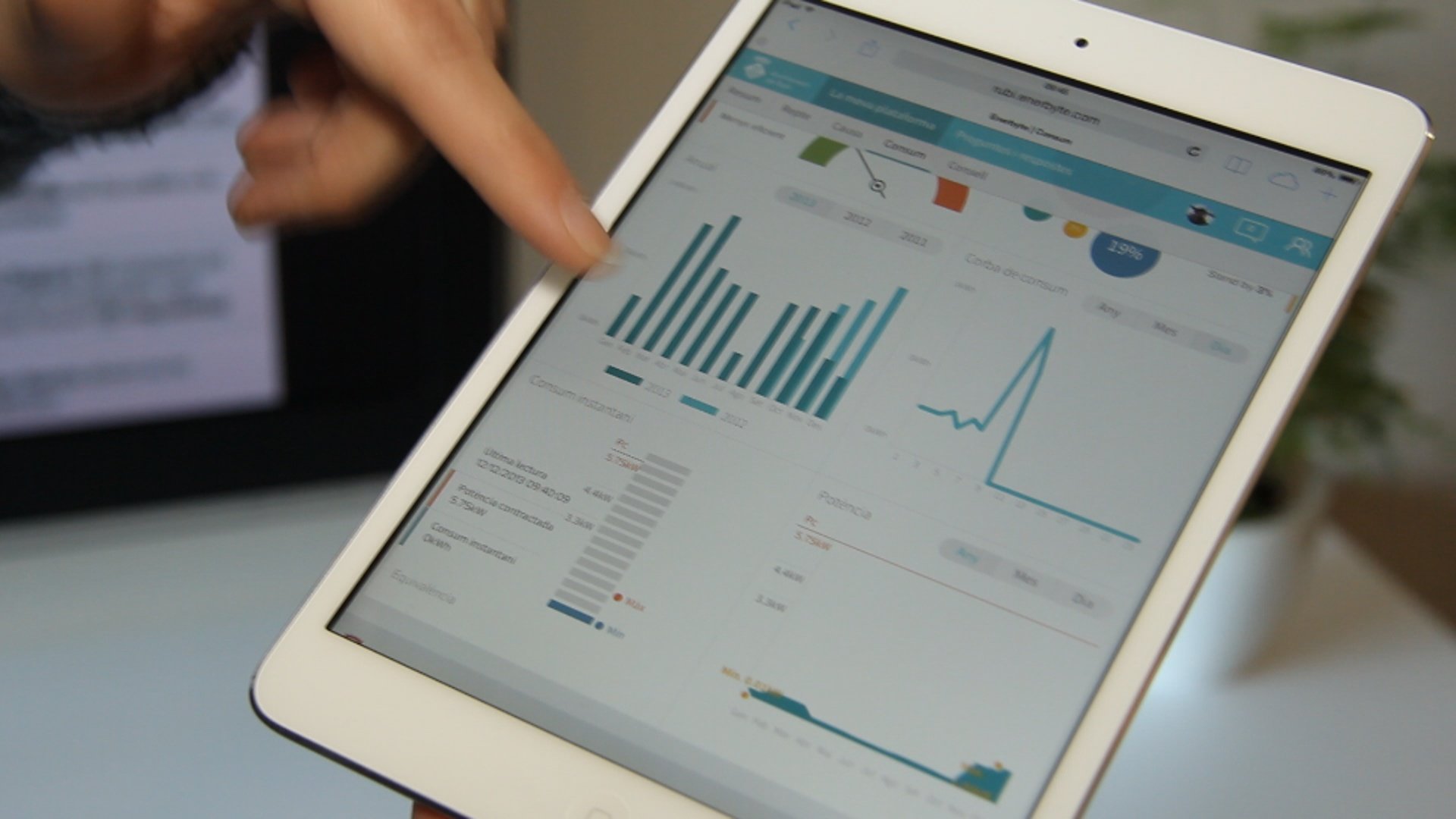
Discussion of energy efficiency often only refers to industrial activity. The domestic sector, which makes up 30% of energy consumption, is often not taken into consideration. It is easy enough to understand the total to be paid when the electricity bill arrives, but not the details of consumption or why your bill is higher or lower. This is what the start-up Enerbyte hopes to solve with the app Visual Energy Advisor.
It is a project that aims to transfer the benefits of technology to everyday life. It collects and cross-references basic information automatically, such as the household profile and electricity expenditure, to help the public to make savings by changing to more sustainable habits, something that makes the app a pioneering initiative in Spain. Moreover, it is one of the three Catalan finalists in the Mobile Premier Awards, prizes given as part of the Mobile World Congress.
Social education in efficiency
It costs nothing, all it requires is allowing the start-up access to your electricity meter to collect consumption data so that it can process all of the information. "From here, we turn on the machinery so that the citizen can learn about practical aspects," says cofounder and Chief Strategy Officer (CSO), Pep Salas, "because if I tell you that your consumption is 40 kw/hour, you won't understand it, it needs to be contextualised within the community." In other words, comparing your expenditure with that of your neighbour or the previous year.
For Salas, this is one of the most important steps, as it creates "social pressure": "You cannot be less efficient than your neighbour, as that will make you modify your behaviour. It is not only for an economic vector, it is to compete and cooperate." The app works like a game, with surveys, challenges, rankings, position comparatives, user points, medals, and so on. And, naturally, useful tips about when it is cheaper to use the washing machine. "The question is to introduce, as a product philosophy, a lot of promotional social strategies and good energy habits," says the cofounder.
What's more, Visual Energy Advisor is in constant contact with the citizen, through the app, a website, periodic newsletters and a report that is sent together with the bill. There are four different strategies that, according to Sales, "allows interaction adapted to the management of each profile." Whatever the best option is for each user, what is clear is that classic generic messages like "Did you know...?" or tips from services that do not know the customer –as with large companies, which in the end are only "interested in business"- do not work.
As for the development of the app, right now the team is conducting a trial phase with the users they have attracted over the past few months. Nevertheless, the CSO says that they are already thinking about the future: "We totally rule out making a tool to manage water or gas, as we prefer to specialise and include novelties, such as solar energy. Being a start-up, one of the lessons that we have learnt is that you have to focus on one thing and do it well."
Social help on a large scale
The B2C business is the first pillar of the start-up, even though monitoring the consumption of users and their habits provides information that is highly valuable to public authorities. "A local authority can cross-reference consumption data in a large block of flats and thus have a trustworthy indicator of the situation; it could also combat energy poverty through social services or knowing which measures for rehabilitating dwellings are more effective," points out the cofounder as examples of how their tool can be used.
Until now, the start-up was one of the Ajuntament de Barcelona's external providers, which gave them the opportunity for this innovative proposal. After an initial pilot programme was a success, the council decided to integrate the technology into its services. It is "good news," says Salas, which gives them "a client with the will to extend the service to the general public." "It is a public-private initiative in which people will have a say in configuring new models of cooperation and in the competitiveness of new services," he adds. .
The bill, a faithful reflection?
Even if we make savings of 10% in electrical consumption, perhaps only a reduction of 4% is seen on the bill when it arrives. According to Salas, this is nothing more than the result of the rise in fixed costs, which do not vary while we are consuming energy. "This situation has no precedent in any other country in Europe," he laments. And he points to the change in regulations as a mechanism that has "clearly benefited" the electrical sector, which did not see an "excessive fall in revenue" during the crisis. "All action taken in the energy sector has a very strong regulatory component," he insists.
In some trials that Visual Energy Advisor has done with real clients they have managed to reduce annual expenditure on electrical energy by up to 70 euros a year. However, Salas says that this figure could be doubled if the bill were to be reduced at the same rate as consumption. .
Far from the European model
"There are three steps the sector has to take: change the regulations, change the regulations and change the regulations," Salas jokes critically, "it is a genuine trap for both citizens and companies that stops us moving towards a more sustainable energy model." He gives the example of the UK, where "through an app, the public can buy and sell renewable energy to a neighbour." It is a situation that cannot happen in Spain with its current legal framework.
In terms of the boost from technology, the CSO thinks that it is becoming established as "a means to democratise basic services," but that it is underused: "We are bound by regulations that seem to be from the 19th century, it is so far from how we live that we cannot get the best out of the progress made." However, the biggest thing is that not only is the legislation out of step with social trends, but also with what the European Union is proposing. According to Salas, that is a democratic model that is "more flexible and open, in which advanced interpretations are allowed." Nevertheless, the cofounder of Virtual Energy Advisor is optimistic and he insists that the efforts being made by new and small companies will eventually bear fruit.
Finalists for the Mobile Premier Awards
In this first quarter of 2016, the start-up is in a phase of running trials of the app in Brussels, Amsterdam and Bergen (Norway). They have made contact with local partners and authorities and all that remains is to wait for users to build up. "Our business plan foresees reaching a million users with the service in 2017 and we hope to start doing this in the second half of this year," says Salas.
In October, the start-up won the Barcelona Smart City App Hack and is now among the finalists for the Mobile Premier Awards, a media shop window that could help them to accelerate their leap into the international sector and to close the investment round they have under way. At the same time, these types of prizes, for the CSO, "provide an extra boost and motivation". "You do not work for recognition, but you are grateful for it because often entrepreneurship is hard and solitary work; and in such an aggressive market, sometimes it can be disagreeable," he adds.
The start-up began a little under two years ago and has a team of 10 people. It was set up with capital of almost 400,000 euros from a private investor who believed at what Salas calls "the Power Point phase," with public grants for entrepreneurs and with the support of KIC InnoEnergy, which is now one of the shareholders.